← Longevity & Supplement Guides
The nightcap illusion: what alcohol does to your sleep and recovery

There is a particular kind of three in the morning that follows a good evening. You went to bed pleasantly heavy, fell asleep faster than usual, and then surfaced at exactly the wrong hour with your pulse running a little warm for a body lying perfectly still. Nothing hurts. Nothing is wrong. You are simply no longer asleep.
Almost everyone recognises that night. Far fewer connect it to the two glasses of wine that made getting into bed feel so easy, because the sedation and the fragmentation arrive hours apart and look like unrelated events. They are the same drink, seen at two different times.
Why a drink feels like it works
Alcohol is a sedative, and sedatives do what they say. The feeling of dropping off quickly is real — but narrower than the folklore suggests. When Gardiner and colleagues pooled 27 laboratory studies for Sleep Medicine Reviews in 2025, shorter sleep onset showed up only at high doses, on the order of five standard drinks or more. At the doses most people actually have on a Friday, falling asleep was not measurably faster; it just felt easier.
That gap between feeling and measurement is the whole story. Sedation is a chemical event; sleep is an architecture. Wellness culture has spent a decade relitigating caffeine down to the milligram while leaving the nightcap almost entirely alone — perhaps because it is the one ritual nobody wants to put a number on.
The second half of the night pays for the first
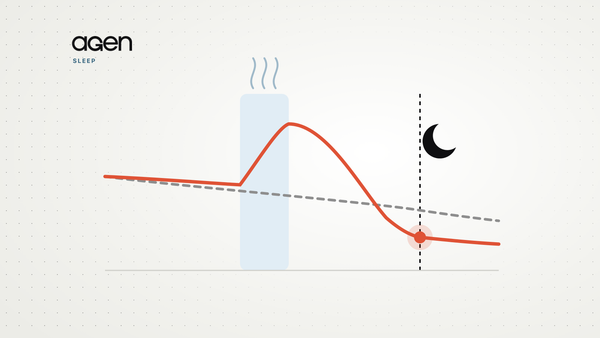
The same meta-analysis found the consistent signature of alcohol on sleep, and it is not in the falling-asleep part. REM sleep started later — about 18 minutes later on average — and there was less of it, roughly 11 minutes less across the night. Crucially, this began at low doses, around two standard drinks, and deepened steadily as the dose rose: each additional gram of alcohol per kilogram of body weight cost around 40 minutes of REM.
REM is back-loaded: scarce in the first hours, concentrated toward morning, which is why the disruption reads as a 3 a.m. problem rather than a bedtime one. As the alcohol clears, the sedative effect withdraws from a nervous system that has been leaning against it for hours, and the last stretch of the night — the part associated with memory consolidation and emotional processing — becomes the lightest and most interrupted. Nothing you drink afterwards "detoxes" it faster; the liver works at its own pace. If the stage names are unfamiliar, start with our guide to what happens in each sleep stage.
Figure 1
One night, two halves
Your morning numbers notice before you do
The most useful recent evidence did not come from a lab. In PLOS Digital Health in 2026, Grosicki and colleagues matched self-reported drinks against 5.1 million person-days of wrist-sensor data from 20,968 adults, comparing each person against themselves rather than against anyone else — which sidesteps most of the reasons drinkers and non-drinkers differ in the first place.
A night one drink above your personal average, set beside a night one below it, came with a nocturnal resting heart rate about 2.8 bpm higher in women and 2.4 bpm higher in men, and heart rate variability about 3.8 ms and 3.3 ms lower respectively. Sleep got shorter as intake rose, and the next day was measurably less active. Effects were larger in women, and larger in people in their twenties than in older adults — the same two drinks are not the same two drinks. Finishing the same amount about an hour earlier recovered part of the cost.
Figure 2
A night one drink above your average, measured at the wrist
These are small numbers for a single night, and that is the point: too small to feel reliably, large enough to see in a trend. If you watch your resting heart rate and your HRV over weeks with something like the Agen Band, alcohol tends to be the most legible thing in the record — more visible than a hard workout, often more visible than a late night.
Where the evidence gets honestly awkward
Two complications keep this from being a tidy story. The first: in Nutrients in 2025, Strüven and colleagues gave 40 healthy adults a defined dose over three consecutive evenings. Nocturnal resting heart rate rose about 3 bpm and settled back within days of stopping — yet the core sleep parameters barely moved. Light sleep, deep sleep, latency and awakenings showed no significant change, while 45% of participants said the nights felt worse. Feeling, architecture and cardiac load disagreed, and the cardiac signal was the one that behaved consistently. Consumer sleep-stage estimates are the softest number on your wrist: treat them as texture, not testimony.
The second complication is the health halo. The old J-shaped curve — light drinkers outliving teetotallers — was for decades the most quoted result in nutritional epidemiology. When Zhao and colleagues re-examined 107 cohort studies for JAMA Network Open in 2023, adjusting for the design quirks that had inflated it (most notably filing former heavy drinkers who had quit for health reasons as "non-drinkers"), the benefit at low intakes was no longer statistically significant, while risk at higher intakes remained, from lower thresholds in women than men. That is an association rather than a verdict, and it says nothing about your particular night. But the curve everyone remembers turns out to have been partly a shape in the method.
What to do with this if you aren't planning to quit
Most people aren't, and this isn't a temperance essay. It is an argument for knowing the price and then choosing it on purpose — a different posture from either abstinence or denial.
Timing is the cheapest lever: finishing three or four hours before bed lets most of the clearing happen while you are still awake, and the wrist data suggests even an hour helps. Dose matters more than the yes-or-no — the relationship is a slope, not a switch, so one glass and three are genuinely different nights. Stop using it as a sleep aid; it is the wrong tool, and the bill arrives after 3 a.m. Expect a bigger effect if you are younger, or a woman, or unusually fit with a low baseline heart rate. And judge the week rather than the night: one flagged morning is noise, a Sunday that never quite recovers is a pattern — the same way to read caffeine, training load and whether to push or rest. If anything about your sleep or heart rhythm worries you, that is a conversation for your doctor, not a wearable.
The bottom line
Alcohol shortens the felt distance to sleep and lengthens the real distance to recovery. The first half of the night gets easier; REM arrives late and leaves early, the heart works harder while you lie still, and the next day is quieter than you intended. None of that makes a glass of wine a mistake. It makes it a trade — and trades are only worth making when you can see both sides, which is the whole case for measuring instead of assuming. Use numbers to correct the fantasy, not to replace the evening.