← Longevity & Supplement Guides
Can You Catch Up on Sleep? What Recovery Sleep Actually Repays

By Thursday, most people have stopped noticing.
Six hours on Monday. Six on Tuesday. Five and a half on Wednesday because of the thing you were reading. By Thursday afternoon you feel roughly normal — not sharp, but normal — and on Saturday you sleep until ten and assume the ledger is settled.
The metaphor is doing a great deal of quiet work in that sentence. "Sleep debt" implies a currency: hours out, hours in, balance restored. It is probably the most useful bad metaphor in health. Useful, because it makes an invisible loss legible. Bad, because the one thing a ledger promises is precisely the thing the evidence declines to deliver.

The strangest result in sleep science
In 2003, Van Dongen and colleagues put volunteers on 4, 6, or 8 hours in bed for fourteen consecutive nights and tested them every day.
Two things happened. Cognitive performance declined in a dose-dependent way — less sleep, worse scores — and the deficits accumulated night after night rather than settling at a new normal.
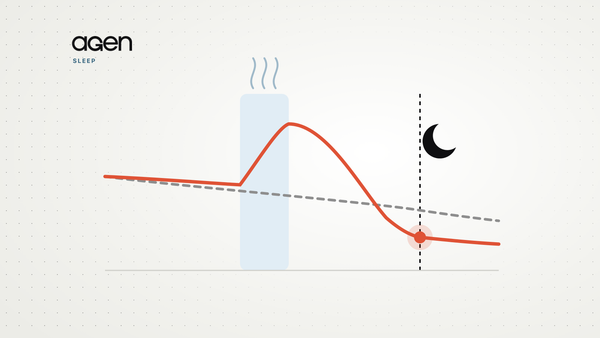
Subjective sleepiness did something else entirely. It jumped at the start, then flattened out, and barely moved thereafter. Most tellingly, it did not reliably separate the 6-hour group from the 4-hour group. Two conditions with visibly different performance costs felt about the same from the inside.
That is the result that should change how you read your own week. Not "sleep loss is bad" — everyone knows that. The finding is that the feeling of being tired stops tracking the cost of being tired. You adapt to the sensation, not to the deficit. You stop feeling worse long before you stop getting worse.
Sleep debt
You stop feeling worse before you stop getting worse
measured cognitive deficit how sleepy people said they felt
Five weeks of recovery sleep, and the blood had not finished catching up
What each of these studies actually did
Van Dongen 2003 — 4, 6 or 8 hours in bed for 14 consecutive nights, with daily neurobehavioural testing, plus a separate total-deprivation arm.
Smith 2021 — 15 adults, 6 weeks, 5 hours on weeknights and 8 hours on Saturday and Sunday.
Depner 2019 — three arms: 9 hours nightly, 5 hours nightly, or 5 hours then free weekend sleep then 5 hours again.
Ochab 2021 — 10 days at about 70% of individual sleep need, then 7 days unrestricted, with EEG.
Cheng 2026 — whole-blood RNA sequencing across 1 and 2 weeks of restriction and 5 weeks of recovery sleep.
Two nights is not a weekend's worth of repair
If the deficit accumulates, the obvious question is whether a weekend clears it. The weekend patch is very likely the most widely practised sleep intervention on earth, and almost nobody has tested it properly.
Smith and colleagues ran the cleanest version: fifteen high-performing adults, six weeks, five hours in bed on weeknights and eight on Saturday and Sunday. A real working pattern, held for a month and a half, with the standard weekend patch built in.
Accuracy fell as sleep debt accumulated — most clearly on vigilant attention and spatial orientation. In the authors' own words, those deficits were not restored by the two nights of weekend recovery sleep.
Several other measures held up fine: working memory, abstract reasoning, cognitive throughput, risk decisions. That is worth saying plainly, because this is not a story about global collapse. It is a story about which things go first. Sustained attention and spatial orientation — the boring, load-bearing functions. The ones you use to drive home.
Fifteen people is a small sample, and high performers on a controlled schedule are not a random slice of humanity. But six weeks is a long time to hold anyone to five hours a night, and studies that long are rare enough that this one earns its place.
What the weekend does downstream
Cognition is not the only ledger. In 2019, Depner and colleagues assigned healthy young adults to three schedules: nine hours nightly, five hours nightly with no reprieve, or five hours through the workweek followed by unrestricted weekend sleep and then five hours again.
Whole-body insulin sensitivity — a measure of how readily the body handles a glucose load — fell by around 13% in the continuously restricted group. In the weekend-recovery group, during the return to short sleep, whole-body, liver and muscle insulin sensitivity fell by roughly 9% to 27%.
Read that twice. The group that got the weekend did not come out ahead. The authors concluded that weekend recovery sleep is not an effective countermeasure to the metabolic disruption that travels with recurrent short sleep.
The likely mechanism is not mysterious. The weekend patch is not simply extra sleep; it is a timing shift. Waking at ten on Sunday and six on Monday moves your body clock by hours, twice a week, in opposite directions. You are buying the recovery with misalignment. Our piece on sleep regularity versus duration covers the cohort evidence that when you sleep often predicts more than how long you sleep.
Some things had not settled a month later
So how long does full recovery take? The honest answer is that nobody has found the bottom.
Ochab and colleagues cut thirteen people to about 70% of their individual sleep need — from a baseline of 7 h 37 min down to 5 h 18 min — for ten days, then gave them a week of unrestricted sleep. Reaction time on the Stroop task came back. Stroop accuracy and daily activity patterns came back partway. EEG measures, including event-related potentials and spectral power, had not returned to baseline by the end of the recovery week.
And this July, a group led by Cheng published something less comfortable still. They sequenced whole-blood RNA across one and two weeks of sleep restriction and then five weeks of recovery sleep. Of the genes knocked off baseline, 68 came back fully. Seventy-four did not — after five weeks. The persistent set was enriched for inflammation-related and ribosomal pathways.
The caveats are real and they belong here: healthy adult males, whole blood, gene expression rather than anything you would notice about yourself. A transcript still sitting off baseline is not a diagnosis and may never become a problem. But it does dispose of the tidy version of the story. Five weeks of unrestricted sleep, and the molecular signature of a two-week shortfall was still legible.
Why "debt" is the wrong word
A debt has one number and one clock. What this evidence describes is a set of systems recovering on entirely different schedules.
Sleepiness settles within a night or two. Mood not long after. Vigilant attention takes longer than a weekend and possibly longer than a week. Metabolic markers can look worse on the weekend-patch schedule than on the steadily short one. Gene expression in some pathways was still off five weeks out.
That is not a balance sheet. It is closer to a building where the lights come back on immediately, the lift takes a week, and the foundation keeps its own calendar. The lights coming back on is the part you can feel. It is also the least informative signal in the building.
Which brings us to the rule this whole blog keeps arriving at: use numbers to correct fantasy, not to replace experience. The fantasy here is manufactured by your own nervous system, free of charge, every Thursday afternoon.
What to do with this on an ordinary week
Three moves that follow from the evidence rather than from a protocol we invented.
Stop auditing your sleep by how you feel. This is the direct implication of Van Dongen: the sensation saturates while the cost does not. Use something that doesn't saturate. Wake time is the cheapest honest signal available — write it down for two weeks, or let the Agen Band keep the record for you, and then look at the spread rather than the average. If your Friday and Sunday wake times sit three hours apart, you do not have a sleep-duration problem. You have a schedule problem.
Shrink the catch-up rather than abolishing it. Nothing in this literature shows that extra weekend sleep is harmful in itself; what looked costly was the size of the shift. An hour is a rounding error to your body clock. Four hours is a time zone. If you are going to sleep in, sleep in a little.
Move the fix upstream. Recovery sleep disappoints because it sits downstream of the loss. The 6-hour group in Van Dongen did not need a better Saturday; they needed a different Tuesday. Thirty minutes earlier, four nights a week, is thoroughly unglamorous and does more than any weekend can. Our guides to caffeine and sleep and to reading a sleep score without fooling yourself are the practical end of that, and the longevity protocol shows where sleep sits relative to everything else. If you want support for the wind-down hour itself, our rest and recovery range is built around that hour rather than around the weekend.
The bottom line
You can recover from lost sleep. You cannot recover from it on a schedule of your own choosing, and you cannot tell from the inside how far along you are. The weekend gives back the feeling of being rested well before it gives back everything that feeling is supposed to stand for — and on at least one measured axis, the big weekend swing looked worse than no weekend at all.
Which makes the useful move the dull one. Not a better Saturday. A slightly earlier Tuesday.