← Longevity & Supplement Guides
Same Weight, Different Body: What Exercise Intensity Does to Aging Muscle

Somewhere in Brisbane, a group of people in their seventies spent six months showing up to a gym three times a week. Some of them worked in gentle, sustainable sessions. Some kept a steady, conversational effort. And some did the thing most of us assume is reserved for the young and the reckless — short, hard bursts, lungs working, then a pause, then again. At the end, the scale told roughly the same story for everyone: a little less body fat. But underneath the scale, where a bathroom reading can never look, the three groups had quietly diverged.
That divergence is the interesting part, and it is the reason a modest exercise study is worth your attention this month.
What the study actually found
The research, published in Maturitas and led by scientists at the University of the Sunshine Coast and The University of Queensland, followed more than 120 healthy older adults — average age 72, average BMI in the normal range — through six months of supervised training. Participants were placed into high-intensity interval training, moderate-intensity training, or low-intensity training, three sessions a week.
All three groups lost some body fat. That is the headline most reports led with, and it is genuinely good news: movement at almost any intensity nudged body composition in a favourable direction. But only the high-intensity group held on to its lean muscle mass. The moderate group lost fat too — and shed a small but measurable amount of muscle along the way. The low-intensity results were less clear and, in the researchers' words, need further analysis.
It is one study, in a group of healthy volunteers, and the muscle differences were modest. It does not overturn anything. But it puts a fine point on a distinction most of us blur.
Weight is the wrong instrument
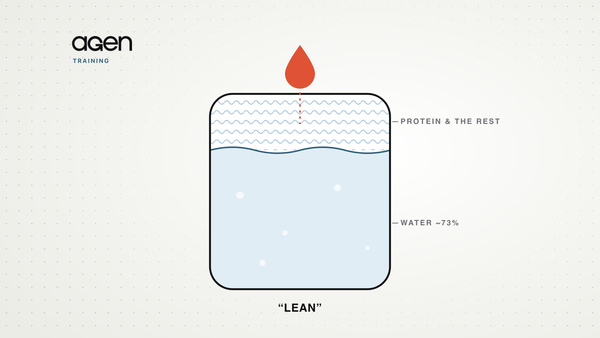
Here is the quiet problem with the bathroom scale: it measures the sum of things you care about and things you don't, then reports a single number as if it meant something. Two people can lose the same three kilograms and be walking away with completely different bodies — one lighter and stronger, the other lighter and frailer. The scale cannot tell them apart. It is the wrong instrument, honestly measured.
What you actually want to track as the years accumulate is composition: how much of you is metabolically active muscle and how much is stored fat. Muscle is the tissue that carries the groceries, catches you when you trip, and quietly keeps your metabolism from going slack. The gradual loss of it with age even has a clinical name — sarcopenia — and it is one of the more consequential background processes of getting older. So a diet or a routine that makes the scale drop while muscle slips out the back door is not a win. It only looks like one.
Under the scale
Same weight change, three different bodies
Why intensity seems to matter
The proposed explanation is refreshingly mechanical. Muscle is expensive tissue to maintain, and the body is a ruthless accountant — it keeps what it is asked to use and quietly sheds what it isn't. A hard interval is a loud request. As study co-author Mia Schaumberg put it, higher intensity puts more stress on the muscles, which gives the body a stronger signal to hold on to muscle tissue rather than let it go.
Gentle movement asks the body for very little, so the body obliges by keeping very little in reserve. That is not an argument against walking — walking is one of the most reliable habits in all of longevity. It is an argument for making sure that somewhere in your week, you ask your muscles a question hard enough that they feel obliged to answer.
How to use this without hurting yourself
None of this is licence to sprint out the door tomorrow. Vigorous exercise carries real cardiovascular risk if you begin too fast, too old, or with an unmanaged condition, and the study looked specifically at healthy older adults under supervision. If you are over a certain age, sedentary, or living with anything clinical, talk to your doctor before you add hard intervals. Intensity is relative: for one person it is a brisk hill, for another a stationary bike. The point is contrast, not heroics.
Sensible ways to add a little intensity
Signals to stop and check with a professional
Where this fits in the Agen system
The practical lesson is not "do more." It is "watch the right variable." If body composition is what matters, then the scale is a poor daily companion and trend data is a better one. You can follow your training intensity and heart-rate zones — and your longer body-composition and recovery trends — with the Agen Band, which is built to show you the direction of travel rather than a single number ripped out of context.
Two supplements have authorized roles worth knowing here, both about supporting normal muscle rather than fixing anything. Creatine at 3 g a day is authorized to enhance the effect of resistance training on muscle strength in adults over 55, and to increase physical performance in short bursts of high-intensity exercise. And adequate dietary protein contributes to the growth and maintenance of normal muscle mass. Neither replaces the training — they support the tissue the training is trying to keep.
If you want the wider picture, this sits alongside our guides to the difference between REHIT and HIIT, strength training after 40, and why VO₂max tracks so closely with a long life — all of which feed into how to build a longevity protocol that adapts to you.
The bottom line
Aging well is less about the number on the scale and more about what that number is made of. Movement at any intensity seems to help with fat; holding on to muscle appears to reward the harder, briefer efforts. Measure composition, not weight; add a little contrast to your week once your foundation is solid; and let your training ask your body a question worth keeping the answer to. The affluent world will keep discussing "biological age" in rooms with expensive lighting. The unglamorous truth is that most of it is decided by whether you asked your muscles to work this week.
This article is for education and wellbeing, not medical advice. It does not diagnose, treat, or prevent any condition. Talk to a qualified healthcare professional before starting vigorous exercise or a new supplement, especially if you have a medical condition.