← Longevity & Supplement Guides
Pink Noise and Deep Sleep: It Was Never About the Sound

Last week a sound became a health intervention.
On 9 September, a team at MIT and Boston University reported in Science Translational Medicine that carefully timed bursts of pink noise, played to sleeping volunteers, produced larger waves of cerebrospinal fluid moving through the brain. Within about forty-eight hours the finding had been compressed into a sentence you could act on tonight: play pink noise, wash your brain.
Millions of people already fall asleep to exactly that sound — rain, a fan, a distant waterfall, whatever the app calls it. So the story landed on prepared ground, and it landed wrong.
The active ingredient in that experiment was not the noise. It was when the noise arrived.
Fourteen people, an MRI scanner, and an afternoon nap
The design is worth picturing, because the picture is the argument. Fourteen healthy adults were asked to fall asleep during afternoon sessions inside an MRI scanner, while an EEG cap recorded their brain waves. That combination is a small engineering nightmare: the scanner's magnetic field swamps the EEG signal it sits on top of.
So the team built a way to strip the scanner's interference out of the EEG in under 100 milliseconds, and then a neural-network approach to predict where the next slow wave would peak. Prediction was the point. By the time you have measured a wave, you have already missed it. Only then did they play the sound: a 50-millisecond burst of pink noise, aimed at a peak that had not happened yet.
Fourteen people. One nap. Inside a tube. The authors call it a proof of concept, and they are right to.

Why a wave of fluid follows a wave of electricity
The backstory starts in the same lab. In 2019, Fultz, Lewis and colleagues reported in Science that during non-REM sleep the brain's slow electrical waves are shadowed by large, slow waves of cerebrospinal fluid washing through it — the two locked together, electricity then fluid, all night.
It was a beautiful observation and a frustrating one, because it was correlational. Did the neural waves drive the fluid? Did both follow something else entirely? You cannot tell from watching.
The 2026 paper is the answer to that seven-year-old question. Push the slow waves from outside, and the fluid waves get bigger. That is a causal arrow, drawn in living humans for the first time. It is genuinely good science, and it deserved the attention it got. It just did not mean what the attention said it meant.
The detail the headlines dropped
Here is the paper's own sentence. The effect was "phase dependent and only apparent when auditory stimuli were aligned with slow-wave peaks."
Read it twice. Sound played at the wrong moment in the wave did not produce the effect. Same sound. Same volume. Same sleeper, the same night. A different millisecond, and nothing.
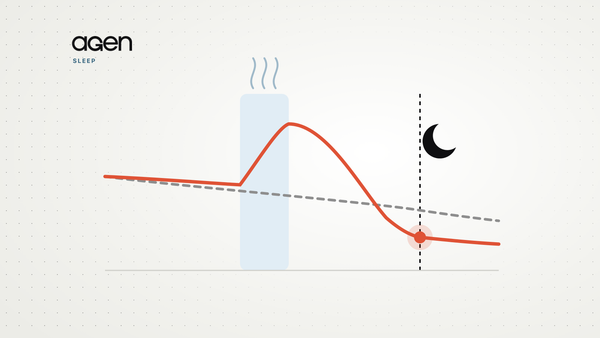
Which makes pink noise not the medicine but the tap on the shoulder — and the entire trick is knowing precisely when to tap.
Laura Lewis, the senior author, said it about as plainly as a scientist can say anything. There is no evidence, she told the Boston Globe, that simply playing continuous pink noise would have the same effect; her team had gone to a great deal of trouble to play the bursts at the specific correct times.
Sleep · how the effect works
The sound is the trigger. The timing is the whole trick.
What this experiment could and could not show
It could show: that driving the brain's slow waves from outside makes the cerebrospinal-fluid waves that accompany them larger — so the neural wave is upstream of the fluid wave, not merely alongside it. And that the effect depends on phase: bursts aligned to slow-wave peaks worked, bursts elsewhere did not.
It could not show: anything about memory, ageing, long-term health or any medical condition. There were 14 healthy adults, napping in the afternoon, in a scanner, for a single session. No outcome beyond the fluid measurement itself was tested, and nothing here describes a way to treat or affect any disease.
Continuous noise has its own file, and it is thinner than you think
The white-noise machine is one of the most widely adopted sleep habits of the last two decades, and almost nobody has checked it properly.
In 2021, Riedy and colleagues published a systematic review in Sleep Medicine Reviews covering 38 studies of continuous white or broadband noise and sleep. The findings scattered across the whole range — some studies found it improved sleep, some found it disrupted sleep. Graded formally, the quality of evidence that continuous noise improves sleep came out as very low. The authors noted that this sits awkwardly against how widely it is used, and flagged possible downsides for both sleep and hearing.
That is not "noise machines are bad." It is something more ordinary and more useful: the confidence attached to them has been borrowed, not earned.
And there is a real thing a noise track does well, which nobody needs a scanner to verify. It masks. If your street is loud, or someone in the building keeps different hours, a steady sound lifts the floor so that intrusions stop standing out against silence. Masking is a perfectly good reason to use one. It is simply not the same as improving the sleep underneath.
Even the timed version has not bought much yet
Closed-loop acoustic stimulation is not new. Labs have spent a decade nudging slow waves in phase, mostly to see whether better slow-wave sleep means better memory.
Wunderlin and colleagues pooled that literature in SLEEP in 2021. Acoustic enhancement did tend to improve overnight memory consolidation, with combined effect sizes around 0.31 in young adults, 0.36 for phase-locked approaches specifically, and 0.44 for the two together. Small, and at trend level. Their own conclusion was that the evidence was not sufficient to recommend commercially available devices.
So: ten years of getting the timing right has produced a small, real, inconsistent effect on memory. The new paper adds a mechanism — the fluid genuinely moves — and a way to watch it happen from inside the scanner. What it does not add is a product.
What the study does not say
Lewis and her colleagues want to take this into clinical populations next. That work has not been done. Fourteen healthy adults napping in a scanner tell you the mechanism is reachable from outside the skull. They tell you nothing about outcomes, in anyone, over any length of time, for any condition — and to their credit, the authors do not suggest otherwise.
It is also worth noticing a word that crept into some of the coverage: "detox." Whenever a brain story reaches for that word, the science has been left behind a paragraph or two earlier. Cerebrospinal fluid clearance is a real, measurable, entirely ordinary piece of physiology. It does not need the vocabulary of a juice cleanse, and anything sold to you in that vocabulary deserves a raised eyebrow.
What to actually do with this, this week
This study hands you no technique. What it hands you is a hierarchy, which is more useful.
Slow-wave sleep is the substrate everything here depends on. A well-funded lab spent years learning to buy a little more of it, 50 milliseconds at a time, inside a multi-million-dollar machine. The things that already move it — and that you control for free — are comparatively dull.
- If you use a noise track and it helps you fall asleep, keep it. Just file it under masking rather than clearance, and keep the volume genuinely low; the Riedy review raised hearing alongside sleep, and a sound playing for eight hours a night is a long exposure.
- If you want more deep sleep, the boring levers have the better evidence. Regular timing beats total duration more often than people expect, and alcohol is the most reliable way to flatten the first half of the night — the half where slow-wave sleep mostly lives. We have gone through both: sleep regularity versus duration and alcohol, sleep and recovery.
- Movement has its own literature here, and it does not require a scanner or a headband: exercise and brain waste clearance.
- Watch the trend, not last night. One night's number tells you almost nothing, which is the argument in sleep beyond a single number. If the stages themselves are new to you, start with sleep stages explained.
The bottom line
The most useful line in all of last week's coverage came from Lewis, and it was not about pink noise at all. She cautioned against chasing perfect sleep, on the grounds that worrying about it can make it harder to come by.
That is the whole thing, really. An elegant experiment showed that the brain's nightly fluid waves can be driven from outside, if you can predict a wave about a tenth of a second before it arrives. The version of that available to you tonight is an audio file on loop — pleasant, sometimes genuinely useful for drowning out a noisy street, and not what was tested.
Use the numbers to correct the fantasy, not to replace the sleep.