← Longevity & Supplement Guides
Sleep Inertia: Why You Can’t Think for the First Twenty Minutes

There is a version of you that exists for about a quarter of an hour every morning, and it should not be allowed near your inbox.
It is not tired, exactly. It is not unwell. It is a specific, measurable, entirely ordinary brain state called sleep inertia — the gap between the moment you are awake and the moment you are actually available. Everyone has it. Almost nobody plans around it. And most of the advice aimed at it, including the line you have heard most often, turns out to rest on less evidence than its confidence suggests.
The twenty minutes you should not be trusted with
Sleep inertia is the transitional grogginess between sleep and wake: slowed reaction time, dented working memory, poor judgement, and the distinct sense that the room is happening to you rather than the other way round. It is not a symptom of a bad night. It is the default condition of a brain that has just been switched between two modes and has not finished the handover.
The 2019 review by Cassie Hilditch and Andrew McHill in Nature and Science of Sleep remains the clearest map of it. Most laboratory measures of performance return to baseline within roughly thirty minutes of waking. Subjective alertness keeps climbing for considerably longer — up to about two hours. And in the worst documented case, with prior sleep loss and an awakening at an unhelpful point in the body clock, performance on an addition task took up to three and a half hours to fully dissipate.
What is striking is not that this happens. It is how badly we account for it. We put our first real decision inside it, we grade the whole night by how it feels at minute three, and then we buy something to fix it.
The feeling clears long before the cost does
Ask people directly and they report something much tidier than the laboratory does. In January 2026, a nationwide Korean survey of 2,355 adults aged 19 to 92, published in PLOS ONE, asked one blunt question: how long does it typically take you to clear the grogginess after waking? The average answer was 15.8 minutes, with a standard deviation of 12.9; the authors split the sample at ten minutes to compare shorter and longer clearers.
Both sets of numbers are true. The gap between them is the interesting part. Fifteen minutes is roughly when you stop noticing it. Thirty minutes to two hours is roughly when it stops costing you. Your own sense of being awake arrives early and confidently, and it is not tracking the thing that matters — a familiar pattern, and the reason we keep writing about the difference between what you feel and what can actually be measured.
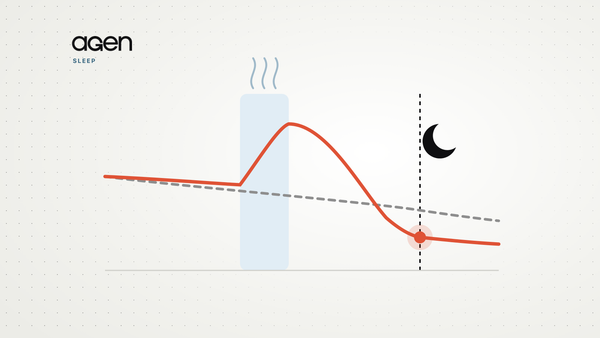
Figure — waking up
How long sleep inertia lasts, according to four published landmarks
The average time people say it takes them to clear morning grogginess, across 2,355 Korean adults (Kim et al., 2026).
When most laboratory performance measures are back at baseline after waking (Hilditch & McHill, 2019).
How long subjective alertness can keep improving — well past the point it stops feeling like grogginess.
The longest impairment reported: an addition task after prior sleep loss and a badly timed awakening.
What lengthens your own version
From the same Korean survey, longer self-reported grogginess tracked with anxiety (about 14 minutes longer on average, Cohen's d = 1.12 — by far the strongest association), insomnia symptoms, evening chronotype, and daytime sleepiness. Shorter grogginess tracked with morning chronotype and longer sleep. These are cross-sectional associations from one self-reported question, not causes.
Grogginess is not a verdict on your night
The Korean survey also mapped who has it worst, and the results are less about sleep than you might expect. Anxiety was the dominant association — roughly fourteen minutes longer, at an effect size (d = 1.12) that dwarfs everything else in the model. Insomnia symptoms, evening chronotype and daytime sleepiness all tracked with longer clearance. Being a morning type and sleeping longer tracked with shorter.
One oddity is worth keeping rather than tidying away: habitual snoring was associated with shorter self-reported grogginess. That is almost certainly not a benefit of snoring. It is a reminder that this is a single subjective question asked once, in a cross-sectional sample, and that some of what it captures is how willing a person is to report feeling bad in the morning. Snorers may simply be less reliable witnesses to their own mornings.
Which points at the thing people find hardest to accept. The first three minutes are not data about your sleep. They are data about waking up, and waking up is difficult for almost everyone. If you want to know how you actually slept, look at the shape of the week — the consistency of your timing above all, which we covered in sleep regularity versus duration.

The case against "never hit snooze"
Here is the advice everyone repeats: the snooze button ruins your morning, fragments your sleep, and sabotages your cortisol. It is stated with total confidence in roughly every morning-routine article ever written. The evidence behind it is remarkably thin.
In 2023, Tina Sundelin, Shane Landry and John Axelsson ran the experiment properly and published it in the Journal of Sleep Research. In their laboratory study, 31 habitual snoozers slept with full polysomnography and were woken two ways on separate mornings: abruptly, or with thirty minutes of intermittent alarms. Snoozing cost about six minutes of sleep. On the cognitive tests taken immediately on rising, it either made no difference or made performance slightly better. There was no clear effect on the cortisol awakening response, on morning sleepiness, on mood, or on the architecture of the night's sleep. And it made people less likely to be hauled out of deep slow-wave sleep — the awakening most likely to leave you wrecked.
The honest limits: 31 habitual snoozers, one laboratory morning, one thirty-minute dose. This is not a mandate for ninety minutes of alarms, and it says nothing about people who do not normally snooze. But the confident version of the advice — that snoozing is self-sabotage — was never supported by much beyond its own tone. If you snooze, cap it near half an hour and stop apologising for it. If you don't, you are also fine.
What your morning actually depends on
The largest attempt to answer that question is a 2022 Nature Communications paper by Raphael Vallat, Sarah Berry, Neli Tsereteli and colleagues. They followed 833 people — including 340 identical and 134 fraternal twins — for about eleven nights each, collecting 89,535 alertness ratings alongside continuous glucose monitoring, accelerometry, and standardised breakfasts.
The twins are the point. If "I'm just not a morning person" were a fact about your genome, it would show up here. It did not: heritability of morning alertness came out at 0.25 with a confidence interval running from −0.34 to 0.84, which is a statistically polite way of saying "we found nothing". Individual-specific environment — habits, in other words — accounted for 57.3% of the variance.
Four modifiable things predicted a better morning, each independently of the others: sleeping longer than your own baseline, waking later than your own baseline, being more physically active the previous day, and eating a breakfast higher in complex carbohydrate — with a lower blood-glucose response after it adding a separate benefit on top.
None of this is exotic, and the limitations are real: alertness was rated on a visual analogue scale rather than measured by EEG, sleep came from accelerometry rather than polysomnography, morning light exposure was not captured at all, and the participants were in robust health. But the direction is the same one almost every strand of this literature points in — yesterday's movement, a breakfast that doesn't spike you, and enough sleep at a consistent hour do more for tomorrow morning than anything you can do at 7am.
The signal that may matter more as you age
In July 2026, a Wisconsin Sleep Cohort analysis in the Journal of Clinical Sleep Medicine asked a sharper question. Jonathan Love, Jesse Cook, Erika Hagen and colleagues gave 461 older adults (mean age 73.8) the 23-item Sleep Inertia Questionnaire alongside six standard cognitive tests.
Higher sleep-inertia scores tracked with worse psychomotor speed on the Grooved Pegboard (p = 0.003) and worse executive switching on Trail Making Part B (p = 0.001). Both held after adjusting for depression, general sleepiness, demographics, sleep characteristics and sleep-disordered-breathing severity. Verbal learning and verbal fluency showed nothing. Notably, the standard daytime-sleepiness scales showed no consistent relationship with any cognitive outcome — the inertia measure did.
Read it carefully, though. It is cross-sectional, sleep inertia was self-reported, the sample was 95% non-Hispanic white and elderly, the cognitive testing happened mostly in the evening rather than on waking, and there was no correction for multiple comparisons. It cannot tell you whether groggy mornings do something to a brain, or whether a brain that is changing produces groggier mornings. Both readings fit equally well.
What it does suggest is narrower and more useful than a headline: how you wake up may carry information that "how sleepy are you during the day" does not. That is a good argument for paying attention to your mornings, and a poor argument for panicking about one of them.
What to actually do this week
Nothing here requires a purchase or a protocol. It requires noticing.
- Hold the wake time, especially at weekends. Consistency of timing is the single most transferable finding in this whole area, and it is also the cheapest.
- Do not schedule the hard thing in minute ten. Move the difficult email, the pricing decision, the tense conversation to somewhere past the half-hour mark. This is the highest-yield change on the list and it costs nothing.
- Get outside within the first half hour. Even an overcast morning is an order of magnitude brighter than your kitchen — see light exposure and circadian health.
- Move yesterday. The Vallat data is clear that activity on day one shows up in alertness on day two.
- Eat something that isn't just sugar, and notice whether the crash arrives ninety minutes later.
- Time the caffeine, don't just increase it. Our guide to caffeine and sleep covers the half-life arithmetic that decides whether this morning's fix becomes tonight's problem.
- Stop grading the night at minute three. Judge it at lunchtime, and judge the week rather than the day. Catching up works better than most people assume, and worse than they hope.
If you want the trend rather than the anecdote, that is what measurement is for: the Agen Band and the Agen app track resting heart rate, heart-rate variability and sleep timing over weeks, which is the timescale on which any of this becomes legible. The longevity protocol hub shows how sleep sits inside the rest of the system, and our rest and recovery range covers the nutrition side. Persistent, severe morning grogginess — or daytime sleepiness that does not resolve — is worth raising with a doctor rather than optimising alone.
The bottom line
Sleep inertia is normal, it is measurable, and it lasts longer than it feels. The average person says it clears in about sixteen minutes; the laboratory says the cost persists for thirty to a hundred and twenty. It is worsened by anxiety, by an evening chronotype and by short sleep, and it is not meaningfully inherited — which means it is mostly a description of your habits rather than your fate.
The one piece of advice everyone repeats about it, that snoozing ruins your morning, does not survive contact with the only proper experiment on the question. And the things that genuinely help are aggressively unglamorous: a steady wake time, daylight, movement the day before, a breakfast that doesn't spike you, and the discipline not to hand your worst twenty minutes anything that matters.
Use the numbers to correct the fantasy, not to replace the morning. You are not broken at 6:40. You are simply not open yet.