← Longevity & Supplement Guides
Sleep Is a Cooling Problem: The Case for a Colder Bedroom

In 1999, a reporter from The Wall Street Journal asked Lee Kuan Yew to name the invention that had done the most for Singapore. He could have said the container port, or the semiconductor, or the rule of law he spent a career building. He said air conditioning. "One of the signal inventions of history," he called it — the thing that "changed the nature of civilisation by making development possible in the tropics." The first thing he did on becoming prime minister, he added, was install air conditioners in the buildings where the civil service worked.
It sounds like a strongman's small joke until you sit through a July afternoon at thirty-two degrees and eighty-percent humidity and try to think. Before the machines, the working day in this part of the world was rationed not by ambition but by thermoregulation. Offices emptied after lunch. Factories ran slow. The body, quietly and without asking permission, closed for business. Lee understood something most of us apply only to our offices and almost never to our beds: a human being is, before it is anything else, a machine that has to shed heat to run. Cool the room and the mind sharpens. He proved it at the scale of a country, in daylight. The same physics is running your night — and most people are sleeping straight through the one lever that works.
Sleep is a cooling problem
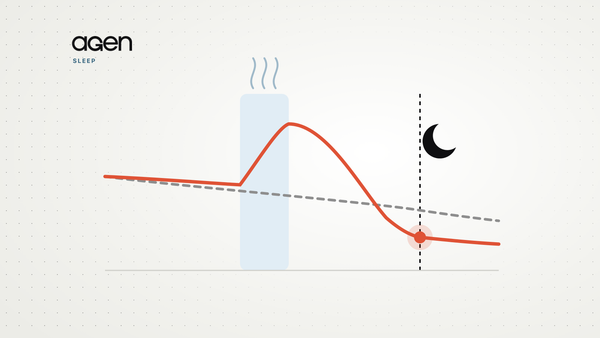
Your core temperature is not a fixed number. It swings on a roughly one-degree Celsius arc across the day: highest in the early evening, lowest in the small hours of the morning, a couple of hours before you naturally wake. That downslope is not a side effect of sleep. It is the invitation. Roughly one to two hours before your usual bedtime, as melatonin rises, the body starts venting heat and the core begins to fall — and it has to fall, by about a degree, for sleep to consolidate. Deep, slow-wave sleep rides the steepest part of that descent. Warm the room past what the body was planning for and you flatten the curve, and the deep stages are the first thing to go.
The physics of the night
Your core temperature falls to let you sleep
The paradox of warm feet
Here is the part that sounds wrong. The fastest way to cool your core is to warm your hands and feet. The body dumps heat through its edges — the wide, shallow vessels in the palms and soles are its radiators. When those vessels open (which is why your feet feel warm as you drift off), blood carries heat from the core out to the skin, and from the skin into the room. When they stay clamped shut — cold feet, a cold nose — the heat has nowhere to go, and the core stays stubbornly high.
Kräuchi and colleagues put a number on this in Nature in 1999, in a paper with the wonderfully blunt title "Warm feet promote the rapid onset of sleep." Across their measurements, the gap between how warm your extremities are and how warm your trunk is — the distal-to-proximal gradient — predicted how quickly people fell asleep better than anything else they measured: better than core temperature itself, better than the melatonin rise, better than heart rate, better than how sleepy people said they felt.
What predicts how fast you fall asleep
Heat leaving through the skin beats every other signal
This is why the two oldest pieces of grandmother advice — a warm bath before bed, and don't go to bed with cold feet — turn out to be the same instruction. A warm bath or shower doesn't sedate you; it floods the skin with blood, opens the radiators, and an hour or so later the core is dropping faster than it would have on its own. The most careful review of this, Haghayegh and colleagues in 2019, pooled the trials and found the timing matters more than the heat: a warm soak roughly ninety minutes before bed shortened the time it took people to fall asleep and improved how well they slept. Ninety minutes, so the warming has done its job and the cooling has taken over by the time your head is on the pillow.
The number on the wall
All of which points at the thermostat, the one appliance in the house that can help you sleep and costs nothing extra to aim correctly. The research clusters tightly. For most adults the bedroom sits best somewhere around eighteen degrees Celsius — call it the mid-teens to low-twenties, with a sweet spot near 18°C (about 65°F). Go much colder and the body starts defending itself against the chill, which fragments sleep in its own way. Go warmer — and this is the common direction of error — and you lose deep sleep and wake more often, especially in the second half of the night when the core is trying to reach its low.
Where to point the thermostat
The bedroom sweet spot is cooler than most rooms
Large datasets from sleep-tracking wearables point the same way. In one analysis running to millions of nights, sleep efficiency fell steadily as bedroom temperature climbed — small per-degree, but it stacks up across a warm summer, and it hits hardest at the ages when sleep is already fragile. None of this requires a three-thousand-dollar cooling mattress. It requires an open window, a lighter duvet, and the nerve to be a little cold when you get in.
What to actually do
The levers, in rough order of how much they return for the effort. Most of this is free, which is precisely why it gets ignored in favour of gadgets.
The cooling protocol
Six levers, cheapest and strongest first
Set the room to ~18°C
The single change with the most evidence behind it. Cool the whole room before you get in — pre-cooling beats fighting a warm room at 2 am.
Warm bath ~90 min before
A ten-minute warm soak opens the skin's radiators so the core drops faster once you're in bed. Timing beats temperature.
Warm socks, cool room
Cold feet keep the radiators shut. Warm the edges, cool the air — the gradient is what actually moves heat out.
Lighter, breathable bedding
The air by your skin, not the wall thermostat, is what your body reads. Ditch the heavy duvet before you turn the heating up.
Mind the evening heat load
A late heavy meal, alcohol, or a hard workout close to bed all push core temperature up when you need it coming down.
Move the air
Humidity blocks heat loss through the skin. A cracked window or a fan matters as much as the number — the lesson of every tropical night.
The Singapore lesson
There is a class edge to all of this that's worth naming, because Lee named it. Cool air used to be a privilege — the difference between the office that could think through the afternoon and the one that couldn't, between the household that slept and the one that lay awake sweating. Air conditioning didn't just make the tropics productive; it quietly sorted who got to be rested. That edge hasn't disappeared. It has moved into the bedroom and put on the costume of wellness — sold back to us as smart mattresses and cooling sheets and subscription hardware, as though the body needed a firmware update rather than an open window.
It doesn't. The physiology here is ancient and cheap. Your core has to fall about a degree; the room can either help it or fight it; warm edges open the vents that let the heat out. Lee Kuan Yew cooled a whole country during the day and got a working population out of it. You have the smaller, easier version of the same problem, and most of the tools are already in the room. As the ledger of this series keeps insisting: use the numbers to correct the fantasy, not to replace the experience. The fantasy is that better sleep is something you buy. The experience — the one worth trusting — is the first cold, clear morning after you finally turned the heating down.
More in this series: what actually helps sleep and recovery, and the wider rest & recovery approach.