← Longevity & Supplement Guides
Caffeine and Sleep: Why the Afternoon Cup Matters

Caffeine is the most widely used psychoactive substance on earth, and one of the most misunderstood. People treat it as free energy with no downside, then can't work out why they lie awake, or wake unrefreshed, or need a second cup by eleven to feel human. The truth is more mechanical and more useful: caffeine doesn't give you energy, it hides tiredness — and it hides it for a lot longer than most people assume.
What caffeine actually does
As you're awake, a molecule called adenosine builds up in the brain, and rising adenosine is a big part of what you feel as "sleep pressure" — the growing urge to sleep. Caffeine works by blocking the receptors adenosine would otherwise dock into. The tiredness doesn't go anywhere; the signal is simply masked. That's the key mental model: caffeine doesn't delete fatigue, it puts a piece of tape over the warning light. When it wears off, the adenosine that accumulated in the meantime is still there waiting — which is the crash.
The half-life problem
Here's the fact that quietly wrecks sleep. Caffeine has a half-life of roughly five to six hours in a typical adult — meaning that long after a coffee, half the caffeine is still circulating. A 2pm cup can leave a meaningful dose in your system at bedtime, still blocking adenosine, still lightening your sleep. You may fall asleep fine and never connect the dots, because the effect isn't "can't sleep" — it's sleep that's a little shallower and less restorative than it should have been. The dose you don't notice is often the one doing the damage.
It lingers longer than you think
Caffeine still in your system at bedtime
Why "I sleep fine" can be misleading
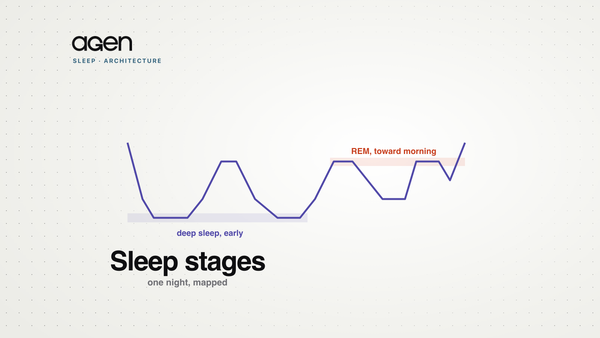
"I can have an espresso after dinner and sleep like a baby" is one of the most common self-reports, and it's usually half-true. You can fall asleep with caffeine on board — falling asleep is driven by high sleep pressure, which can overpower the block. What suffers is the quality: caffeine late in the day tends to reduce deep, slow-wave sleep and can shift the architecture, so you sleep the same hours but bank less restoration. Because you don't consciously feel the missing deep sleep, the cost hides in plain sight — you just wake a little less recovered and reach for the first cup to fix it, closing the loop.
Your genes set your limit
People aren't equally sensitive, and it's largely genetic. A liver enzyme (CYP1A2) breaks caffeine down, and the version you inherited makes you a fast or slow metaboliser — fast metabolisers clear it quickly and may genuinely be fine with afternoon coffee, while slow metabolisers can feel a lunchtime cup at midnight. This is why blanket rules fail and self-experiment wins: the honest test is to move your last caffeine earlier for a week or two and watch your sleep trends and how you feel, rather than trusting either the label or your friend's tolerance.
Tolerance and diminishing returns
There's a quiet trap in daily use. Block adenosine receptors often enough and the brain adapts by making more of them, so over time the same coffee does less — you climb the dose just to feel normal, while the sleep-disrupting effect doesn't fade nearly as fast as the buzz does. The result is a lot of people drinking a lot of caffeine for very little lift, and paying for it at night. The useful experiment is a short reset: ease off for a week or two (expect a few groggy, headachy days as the receptors readjust) and you'll often find a single well-timed morning coffee lands harder than four scattered cups ever did. Less, earlier, is usually more.
A sensible caffeine routine
You don't have to quit — caffeine has a genuine, authorized role in alertness and concentration, and used well it's a fine tool. Used carelessly it steals sleep and then sells you more of itself. A reasonable default:
- Set a cut-off — roughly eight to ten hours before bed, which for most people means no caffeine after early afternoon.
- Delay the first cup — waiting an hour or so after waking, rather than drinking on an empty just-woken system, can smooth the day's energy for some people.
- Mind the hidden sources — tea, cola, energy drinks, pre-workout, and dark chocolate all count.
- Watch your own trend — adjust the cut-off based on your sleep, not a rule.
The bottom line
Caffeine masks tiredness rather than removing it, and with a five-to-six-hour half-life it lingers far into the evening — so an afternoon cup can quietly cost you deep sleep even if you fall asleep fine. Sensitivity is largely genetic, so find your own cut-off by experiment, keep caffeine to the first half of the day, and remember the crash is just the fatigue you postponed. It sits inside the bigger picture of a well-set body clock and healthy sleep architecture. Educational only, not medical advice.